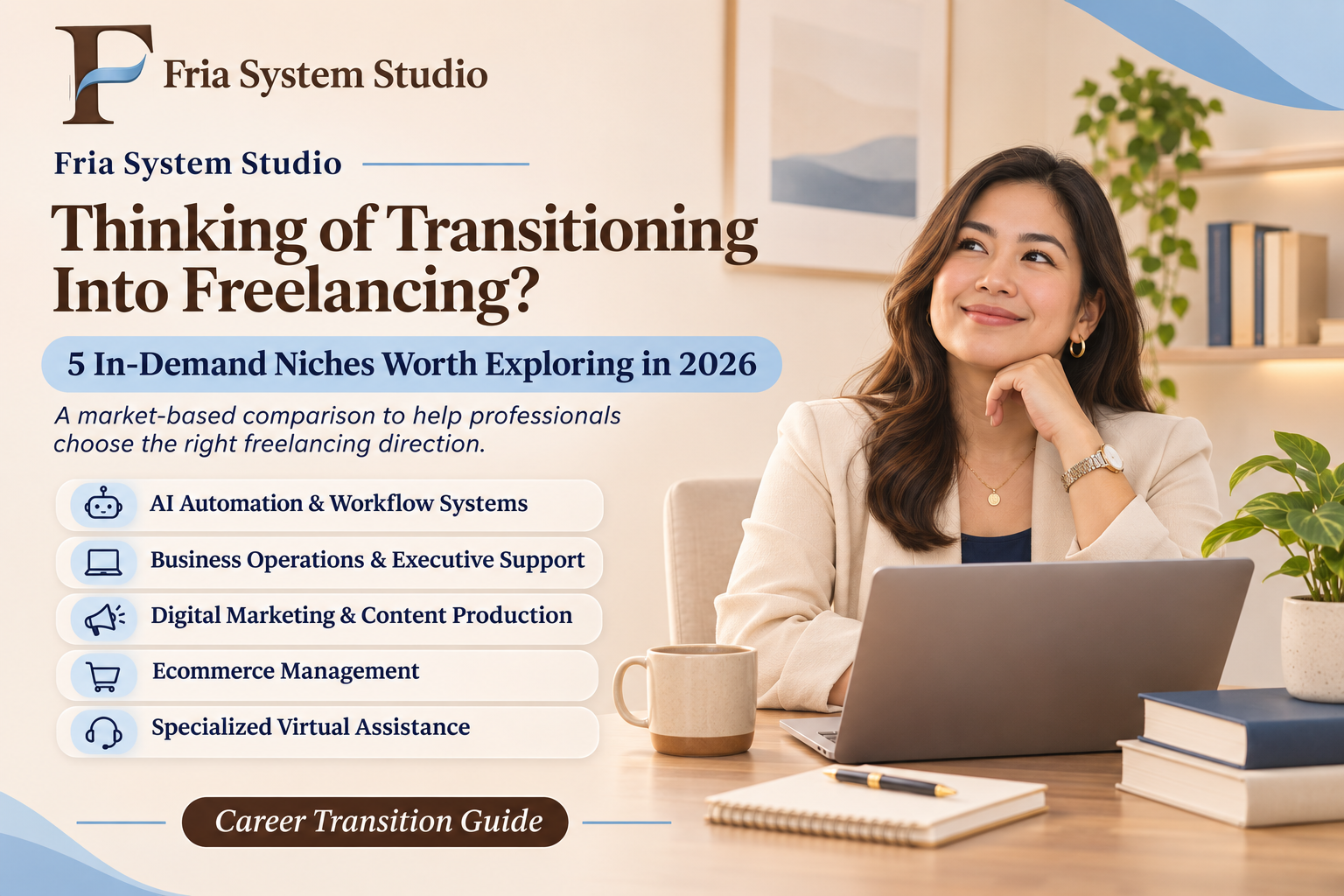
← Back to the BlogThinking of Transitioning Into Freelancing? Here Are 5 In-Demand Niches Worth Exploring in 2026
A Market-Based Comparison to Help Working Professionals Choose Their Freelancing Direction
By Fria System Studio |
You have spent years building your professional experience. Perhaps you are a teacher, an administrative officer, a marketing professional, a customer service representative, or someone working in corporate operations.
You have developed skills, learned how organizations operate, managed responsibilities, and solved problems in your workplace.
Now, you are considering freelancing.
But where should you begin?
One of the biggest challenges professionals face when transitioning into freelancing is not necessarily a lack of skills. It is understanding how their existing experience translates into services that businesses are willing to pay for.
With countless online courses promoting virtual assistance, digital marketing, artificial intelligence, and other remote opportunities, choosing a niche can feel overwhelming.
The question should not simply be, “Which freelancing niche is popular?”
A more useful question is:
“Which niche has market demand, aligns with my existing strengths, and offers opportunities for sustainable professional growth?”
To explore that question, we examined findings from Upwork's 2026 In-Demand Skills Report, Fiverr's 2026 Business Trends Index, and LinkedIn's Skills on the Rise research.
Here are five freelancing niches worth considering—and how they compare.
Understanding the Freelancing Market in 2026
Before choosing a niche, it helps to understand what businesses are purchasing from freelancers.
According to Upwork's February 2026 report, demand for skills explicitly related to artificial intelligence increased by 109% year over year, based on freelancer earnings across selected marketplace categories.
However, the same report also identified consistently strong demand for established services, including general virtual assistance, graphic design, digital project management, and marketing.
This distinction matters.
A fast-growing niche is not automatically the best niche for every beginner.
Some specialties experience rapid growth because businesses are adopting new technologies. Others maintain strong demand because organizations consistently need those services to operate.
For someone transitioning from traditional employment, the best opportunity may be an established service that uses skills they already possess.
For another professional with a technical background, a rapidly expanding specialization may provide a stronger direction.
Understanding both growth and stability makes niche selection more practical.
1. AI Automation and Workflow Systems
A rapidly growing market with higher technical requirements
Artificial intelligence has moved beyond content generation. Businesses are increasingly exploring ways to incorporate AI into daily operations.
These include automating repetitive administrative work, connecting business applications, developing chatbots, processing information, and improving reporting workflows.
Upwork reported that AI integration grew by 178%, while AI chatbot development increased by 71% year over year.
Fiverr's September 2026 research also identified growing search interest in automation tools, including n8n.
These figures suggest that businesses are increasingly interested in practical AI implementation.
What professionals in this niche do
An AI automation specialist might help a company connect its website inquiries to a customer relationship management system, organize incoming customer data, automate routine notifications, or create an AI assistant that answers common questions using approved business information.
The work often requires understanding the business process before selecting the technology.
Who should consider this niche?
Professionals with experience in information technology, systems administration, data management, process improvement, or business operations may find this specialization particularly relevant.
Those without a technical background can enter the field, but they should expect a more substantial learning period.
Advantages and challenges
The main advantage is the growing interest in automation and the opportunity to build specialized expertise.
The challenge is that businesses often expect functioning systems, not simply familiarity with AI tools.
Automation specialists must understand integrations, data handling, security, testing, and troubleshooting. They may also carry responsibility for maintaining systems after deployment.
Market comparison: Compared with traditional virtual assistance, AI automation shows stronger recent growth in specific technical categories, but generally requires more specialized preparation.
Career transition insight: Consider this niche if you enjoy solving process problems, experimenting with technology, and learning how different systems work together.
2. Business Operations and Executive Support
Established demand built around organizational efficiency
While AI receives considerable attention, businesses still need professionals who can coordinate people, organize responsibilities, track deliverables, and support decision-making.
Upwork's 2026 report places general virtual assistance among the most in-demand skills in customer service and administrative support. Digital project management and executive virtual assistance also appear in its top ten.
Unlike emerging AI specializations, these services support long-standing operational requirements.
What professionals in this niche do
Business operations and executive support may include:
- Coordinating projects and monitoring deadlines
- Managing professional correspondence and schedules
- Organizing customer and prospect information
- Supporting client onboarding
- Maintaining CRM records and reporting
- Documenting and improving internal procedures
- Coordinating communication between teams
The level of responsibility varies considerably. An entry-level administrative assistant may handle routine tasks, while an experienced operations professional may oversee workflows and help implement business priorities.
Who should consider this niche?
This is a practical transition path for administrative employees, executive assistants, office managers, project coordinators, teachers with organizational responsibilities, and experienced customer service professionals.
Many of the core skills already exist within traditional workplaces.
Advantages and challenges
A major advantage is the transferability of experience.
Someone who has coordinated school programs, managed administrative records, supervised team activities, or organized projects may already possess useful foundations for this work.
The challenge is differentiation.
Basic administrative services may face substantial competition, especially when providers offer similar task-based support.
Professionals can strengthen their positioning by specializing in a client type or business function.
For example, instead of offering general administrative assistance, someone could focus on client operations for consulting firms or executive project coordination for small business owners.
Market comparison: Unlike AI automation, this niche does not depend on rapid technological adoption to remain relevant. Its value comes from continuing business needs. However, freelancers must demonstrate reliability, ownership, and organizational judgment to move beyond basic administrative work.
Career transition insight: This may be one of the more accessible starting points for experienced professionals whose strongest skills involve coordination, communication, problem-solving, and execution.
3. Digital Marketing and Content Production
Strong demand driven by the need for visibility and customer engagement
Businesses need to communicate their value, attract prospective customers, and maintain visibility across digital platforms.
This supports continuing demand for marketing and creative services.
Upwork reported 36% growth in social media strategy, while social media marketing, SEO, lead generation, email marketing, and marketing automation remained among its most in-demand sales and marketing skills.
Fiverr's 2026 Business Trends Index also found increasing search interest in YouTube-related services, Instagram content, video editing, and Canva design.
For example, its research reported a 403% increase in searches for Canva designers within its Graphics & Design category.
However, marketplace search growth should not be interpreted as a guaranteed increase in paid projects or earnings.
What professionals in this niche do
Digital marketing covers several distinct services.
A content creator may produce graphics, videos, or written content. A social media specialist may manage publishing schedules and audience engagement. An SEO professional may improve website content and search visibility.
A marketing strategist, meanwhile, focuses on the relationship between content, audiences, campaigns, and business objectives.
These are related services, but they require different competencies.
Who should consider this niche?
Professionals with backgrounds in writing, teaching, communications, journalism, graphic design, sales, public relations, or marketing may find opportunities here.
Teachers, for example, may have experience explaining complex information, building engaging presentations, and communicating with different audiences. These abilities can support educational content development and instructional marketing.
Advantages and challenges
Digital marketing provides several possible entry points.
A professional might begin with content writing, presentation design, or basic content coordination before developing expertise in SEO, marketing analytics, video production, or campaign strategy.
However, competition can be significant.
Businesses increasingly have access to templates, AI-generated content, and inexpensive production tools. As a result, the ability to create attractive materials is not always enough to distinguish a service provider.
Understanding audience needs, brand positioning, distribution, and performance measurement can provide a stronger professional advantage.
Market comparison: Digital marketing offers more creative specialization than business operations. It also provides more accessible starting points than advanced automation. However, its results are often measured through audience growth, leads, engagement, or conversions, which can be influenced by factors beyond the freelancer's control.
Career transition insight: Consider this niche if you enjoy communication, research, storytelling, creative production, and understanding how businesses reach customers.
4. Ecommerce Management
A growing specialization combining operations, technology, and customer experience
Online stores require more than an attractive website.
Behind every customer order are product records, inventory information, payment processes, shipping coordination, customer questions, and operational decisions.
As ecommerce businesses grow, owners may need assistance managing these activities.
Upwork identified ecommerce management as the fastest-growing skill in its customer service and administrative support category for 2026, reporting 130% year-over-year growth.
This is a substantial growth signal within the marketplace, although it does not establish ecommerce as the fastest-growing freelancing niche overall.
Fiverr's research also indicates interest in Shopify-related design, development, and optimization work.
What professionals in this niche do
An ecommerce operations specialist may manage product listings, update inventory records, coordinate order processing, address customer inquiries, maintain store information, or prepare sales and operational reports.
More advanced work may include store optimization, merchandising analysis, automation, or integration with other business systems.
Who should consider this niche?
Professionals with experience in retail, merchandising, logistics, inventory management, customer support, sales administration, or business operations may have transferable skills.
Familiarity with online selling can also be useful, although managing a client's ecommerce business requires more structured responsibilities and accountability.
Advantages and challenges
One advantage is that the tasks are closely connected to everyday commercial activity.
Businesses need products accurately listed, orders monitored, customer concerns addressed, and information updated.
This can create opportunities for continuing operational support.
However, ecommerce activities may be time-sensitive, particularly during promotions, peak shopping periods, or shipping disruptions.
Some roles also require proficiency in Shopify or another ecommerce platform, product data management, and performance reporting.
Market comparison: Ecommerce management combines the organizational responsibilities of business operations with the platform knowledge required in technical services. Its recent marketplace growth is stronger than several established administrative categories, but it also demands familiarity with online retail processes.
Career transition insight: Consider this niche if you enjoy structured workflows, product management, customer experience, and commercial operations.
5. Specialized Virtual Assistance
Industry knowledge as a competitive advantage
Virtual assistance is often presented as one broad profession.
In practice, the services required by a healthcare practice, law firm, education business, financial company, or real estate agency can differ substantially.
This creates opportunities for professionals who already understand a specific industry.
A particularly visible example is medical virtual assistance.
Upwork reported 44% growth in medical virtual assistance in its 2026 research.
That figure applies specifically to medical virtual assistance. It should not be interpreted as a growth rate for every specialized VA category.
What professionals in this niche do
Specialized virtual assistants provide administrative or operational services adapted to an industry's requirements.
For example, medical virtual assistants may assist with scheduling and administrative coordination. Real estate assistants may maintain property information and coordinate inquiries. Education-focused assistants may support instructional programs, learning resources, and student administration.
The key difference is not merely the tools they use.
It is their understanding of the professional environment in which the work takes place.
Who should consider this niche?
Professionals with existing industry experience may have an advantage.
A teacher considering remote work may explore educational operations or curriculum support. A healthcare administrator may investigate medical virtual assistance. Someone experienced in property management may consider real estate support.
Existing knowledge can shorten the time needed to understand client terminology, processes, and expectations.
Advantages and challenges
Specialization can help professionals present a clearer value proposition.
Instead of competing broadly as a general assistant, they can explain how their previous industry experience supports a particular client's operations.
However, some specialties involve privacy, regulatory, and documentation requirements.
For example, healthcare-related work may involve protected patient information and require appropriate training, safeguards, and familiarity with applicable laws.
Market comparison: Specialized virtual assistance may offer a stronger connection to previous professional experience than AI automation or general content production. Its main advantage is industry familiarity, while its challenge is that some fields require specialized systems knowledge or compliance training.
Career transition insight: Before learning a completely unrelated skill, examine whether your current profession has a remote-service equivalent.
Comparing the Five Niches: Which Offers the Right Opportunity?
The following comparison combines observed marketplace trends with a practical assessment of typical entry requirements.
The ratings for entry difficulty, competition, and growth potential are editorial judgments, not standardized measurements supplied by Upwork or Fiverr.
| AI Automation & Workflow Systems |
AI integration +178% |
Higher |
Requires technical implementation and testing skills |
| Business Operations & Executive Support |
General VA and project management among the top ten admin skills |
Low to moderate for experienced professionals |
Must differentiate beyond routine tasks |
| Digital Marketing & Content Production |
Social media strategy +36% |
Low to high depending on specialty |
Competitive; proof of results matters |
| Ecommerce Management |
Ecommerce management +130% |
Moderate |
Requires platform and retail workflow knowledge |
| Specialized Virtual Assistance |
Medical VA +44% |
Moderate; varies by industry |
Industry expertise and compliance may be necessary |
Source: Upwork 2026 In-Demand Skills Report. Percentages are year-over-year changes in marketplace freelancer earnings for specific skills, not comparable estimates of total industry size.
Which niche has the strongest growth?
Based on the specific Upwork growth figures examined, AI integration shows the highest increase among the five examples, followed by ecommerce management.
However, percentage growth measures the rate of change from an earlier level. It does not tell us which market has the most projects, the highest average earnings, or the largest number of available clients.
A niche that grew by 178% from a relatively small base may still have fewer opportunities than a mature service category.
This is why rapid growth should be considered alongside existing demand.
Which niche may be easier for an experienced professional to enter?
Business operations, executive support, and industry-specific virtual assistance may offer smoother transitions for professionals with relevant workplace experience.
An administrative officer does not necessarily need to reinvent their career to support a business remotely.
Likewise, teachers, healthcare employees, and other industry professionals may find opportunities closely related to what they already know.
They will still need to understand remote collaboration, client expectations, digital platforms, and independent service delivery.
Which niche offers creative opportunities?
Digital marketing and content production provide numerous paths for professionals interested in communication, design, writing, and multimedia.
The distinction is that creative ability must increasingly be combined with business understanding.
A business does not need content simply because content is available. It needs communication that serves a purpose.
Which niche requires the greatest technical investment?
AI automation generally involves the steepest technical learning requirements among the entry paths compared here.
However, there are substantial differences between basic workflow automation and advanced AI system development.
Professionals should evaluate the specific services they intend to offer rather than treating every AI-related role as requiring the same level of expertise.
Which niche is most likely to support long-term professional growth?
All five can lead to more advanced work, but none guarantees long-term stability.
Business operations may develop into operations management or strategic project coordination.
Marketing services can progress toward campaign strategy, brand management, or performance marketing.
Ecommerce support may develop into store operations management or ecommerce optimization.
Industry-specific virtual assistance can lead to more specialized administrative or consulting work.
AI automation can progress toward systems integration, solution design, and ongoing technical advisory services.
The common factor is the professional's ability to develop expertise beyond completing isolated tasks.
Your Existing Profession May Already Point Toward Your Niche
One common misconception about freelancing is that career changers must abandon their professional backgrounds and start learning an entirely new field.
That is not always necessary.
Consider how existing experience can translate into remote services.
| Teacher or education professional |
Curriculum development, learning design, educational operations, content creation |
| Administrative officer |
Executive support, project coordination, business operations |
| Customer service representative |
Client experience, customer success support, ecommerce customer service |
| Marketing or communications employee |
Content strategy, copywriting, digital marketing |
| Retail or sales professional |
Ecommerce operations, CRM support, lead coordination |
| IT or systems professional |
AI integration, workflow automation, technical support |
| Healthcare administrative professional |
Medical virtual assistance, healthcare administrative support |
| Accountant or finance professional |
Bookkeeping, financial administration, reporting support |
These are examples of transferable career directions, not claims that each specialty has the same level of market demand.
The goal is to identify where your experience intersects with a problem businesses need solved.
A teacher may understand instructional design more deeply than someone who has only learned to create slides.
An experienced administrative employee may understand deadline management and stakeholder communication better than someone who has only completed a virtual assistant course.
A sales professional may already understand customer relationships, follow-up systems, and business development.
These abilities have value.
The challenge is learning to translate them into clear, client-focused services.
Choosing a Niche: Five Questions to Ask Before Investing in Training
Before enrolling in another online course or purchasing a new software subscription, consider five questions.
1. What professional skills do I already possess?
Review your work history.
Identify the responsibilities you have consistently handled, the systems you have used, the problems you have solved, and the outcomes you have helped achieve.
Look beyond your job title.
2. What business problem can my skills solve?
Clients usually purchase services because they need something accomplished.
A founder may need help coordinating projects. An online store owner may need reliable order management. A consulting business may need better client onboarding.
Define the business problem before describing your service.
3. Is there evidence that clients purchase this type of work?
Research freelance marketplaces, job descriptions, service providers, and businesses within your target industry.
Look for recurring responsibilities, commonly requested tools, and identifiable client needs.
Market reports provide useful direction, but reviewing actual client requirements can help you validate a narrower specialization.
4. How much additional learning will I need?
Some services may require only modest adjustments to your existing skills.
Others may involve new software, technical systems, certifications, or regulatory knowledge.
Consider the cost of training, the time you can realistically dedicate, and the level of proficiency needed before accepting client work.
5. Can I demonstrate my ability to deliver results?
A portfolio does not always require previous freelance clients.
Professionals can create clearly labeled sample projects using fictional businesses, simulated scenarios, or authorized non-confidential work.
For example, an aspiring operations assistant could develop a sample client onboarding workflow.
A content specialist could produce a campaign plan for a hypothetical business.
An ecommerce assistant could create a demonstration product catalog.
What matters is showing how you think, organize, execute, and solve problems.
A Practical 30-Day Starting Plan for Career Shifters
Transitioning into freelancing does not have to begin with immediately leaving your current job.
A more manageable approach is to validate your direction before making significant career decisions.
Week 1: Assess your existing skills.
Review your professional experience and identify two possible niches. Research the services businesses request within each one.
Week 2: Select a focused service.
Choose one service you can realistically learn or deliver. Identify a target client group and the specific problem you want to solve.
Week 3: Build evidence of your work.
Create one or two portfolio samples that demonstrate your capability. Document your process and explain what the work is intended to achieve.
Week 4: Test your positioning.
Prepare a professional profile, review relevant freelance opportunities, and begin thoughtful outreach to suitable prospective clients.
Evaluate responses rather than assuming that a lack of immediate results means the niche has no potential.
Thirty days may be enough to establish direction and begin testing a service, but it is not a guaranteed timeline for securing a client or replacing employment income.
For employed professionals, maintaining financial stability while developing a freelance practice may be the more prudent approach.
Beyond Market Demand: What Makes a Freelancing Career Sustainable?
A market trend can help someone decide what to learn.
It cannot, by itself, build a sustainable freelance career.
Long-term professional growth also depends on communication, reliability, continuous learning, ethical practice, and the ability to deliver work that meets business needs.
This aligns with LinkedIn's February 2026 Skills on the Rise research, which identifies growing importance in areas including cross-functional collaboration, stakeholder communication, business development, and technical AI skills.
Businesses may adopt new tools, but they still need people who can understand objectives, make informed decisions, coordinate responsibilities, and communicate effectively.
For transitioning professionals, this is an important reminder.
Your previous experience is not irrelevant simply because you are moving into a new working environment.
In many cases, it is the foundation of your competitive advantage.
Final Thoughts: Choose a Niche Based on Direction, Not Hype
There is no single freelancing niche that is right for everyone.
AI automation demonstrates strong growth but often requires technical preparation.
Business operations and executive support offer established demand and may provide a natural transition for experienced professionals.
Digital marketing creates opportunities for creative and analytical work, but competition makes differentiation important.
Ecommerce management combines business operations with specialized platform knowledge.
Industry-specific virtual assistance allows professionals to apply existing expertise to a more defined client market.
Each presents opportunities. Each also comes with limitations.
The purpose of researching market demand is not to chase every emerging trend.
It is to make an informed decision about where your professional experience, interests, and future development can create value.
You do not have to begin your freelancing journey by becoming someone entirely different. You can begin by recognizing what you already know, identifying where it is needed, and learning how to offer it professionally.
That is a practical foundation for transitioning into freelancing.
About Fria System Studio
Fria System Studio focuses on business operations, learning experience design, and practical digital systems. Through its Student Hub, it supports aspiring freelancers and professionals exploring new career directions through skills development, guided resources, and portfolio-building activities.
Explore the Fria System Studio Student Hub to start identifying your strengths, understanding potential services, and developing practical work samples for your freelancing journey.
Research Sources
1. Upwork (February 4, 2026). Upwork's In-Demand Skills 2026: Demand for Top AI Skills More Than Doubles as AI Is Embedded Into Everyday Work.
https://www.upwork.com/press/releases/upworks-in-demand-skills-2026-demand-for-top-ai-skills-more-than-doubles-as-ai-is-embedded-into-everyday-work
2. Fiverr (September 13, 2026). Business Trends Index 2026: AI Automation Edition.
https://www.fiverr.com/resources/guides/reports/business-trends-index-june-2026
3. LinkedIn (February 24, 2026). Skills on the Rise: The Fastest-Growing Skills in 2026.
https://news.linkedin.com/2026/Skills-on-the-rise-2026
Research note: Upwork's findings are based on freelancer earnings on its marketplace, with demand originating in the United States. Fiverr's report analyzes global marketplace searches across two periods between May 2025 and April 2026. LinkedIn's research examines skills acquisition and hiring patterns across 12 markets. These datasets have different methodologies and should not be treated as directly comparable measurements of global freelance employment, pay, or client availability.